Quick answer
If your school is following the reported 2026 stream rule, Economics is being treated as a commercial-stream subject rather than a general elective. In practical terms, that means many science students would no longer register Economics inside their WAEC subject combination. The safe move is not to argue with rumors on social media. The safe move is to confirm the exact subject list your school is submitting to WAEC and check that it still supports your course plan.
What this guide covers
Why searches for the new WAEC subject list 2026 are rising so fast
Students normally begin to care about subject combinations only when registration is close, but 2026 feels different because the conversation is touching both examination choice and future admission. A science student who always assumed Economics was available as an extra subject now wants a yes-or-no answer. A parent who already paid school fees wants to know whether the school registered the right papers. A student aiming for Accounting, Economics, Estate Management, Mass Communication, or a business-related course wants to know if the WAEC subject combination still supports that ambition.
This is why the phrase compulsory WAEC subjects 2026 has become so important. When people say compulsory subjects, they are really asking two different questions at the same time. First, which subjects must almost every candidate register? Second, which electives are allowed or disallowed for a given stream? Confusion grows when those two questions are mixed together.
There is also a second layer of confusion: schools do not always explain stream rules in the same language. One school may say, "Economics is now reserved for commercial students." Another may say, "Science students should no longer combine Biology, Physics, Chemistry, and Economics in the same WAEC entry." Those statements point to the same outcome, but they sound different enough to create panic. That is why a clean guide matters.
What students are hearing changed in WAEC 2026
The big issue in circulation is that Economics is no longer being treated like a cross-stream subject for everyone. Instead, it is being framed as a business or commercial subject. If your school follows that direction, then Economics moves closer to Commerce, Financial Accounting, Office Practice, and other commercial electives, while science candidates are expected to focus on the traditional science pathway.
For many students, this feels surprising because Economics has always sat in that middle space between social science, business, and general academic planning. Science students often picked it because it looked useful, manageable, and relevant to future courses. Humanities students sometimes kept it because it strengthened a mixed arts-and-social-science profile. Once a rule narrows that flexibility, students naturally search for confirmation.
What matters here is not only whether the rule exists, but how it affects your actual registration sheet. In WAEC planning, theories do not matter. The form your school submits matters. If the school portal or final registration document does not include Economics for your stream, then the online argument is already over. Your only useful question becomes: what approved replacement gives me the best academic and admission value now?
Students
Need to know whether their preferred subject list still works and whether any replacement subject keeps them eligible for future courses.
Parents
Need a practical checklist so they can ask the school the right questions before fees are wasted on the wrong registration plan.
Schools
Need to communicate stream boundaries clearly, especially when a subject like Economics used to feel available to nearly everyone.
The compulsory WAEC subjects students keep asking about
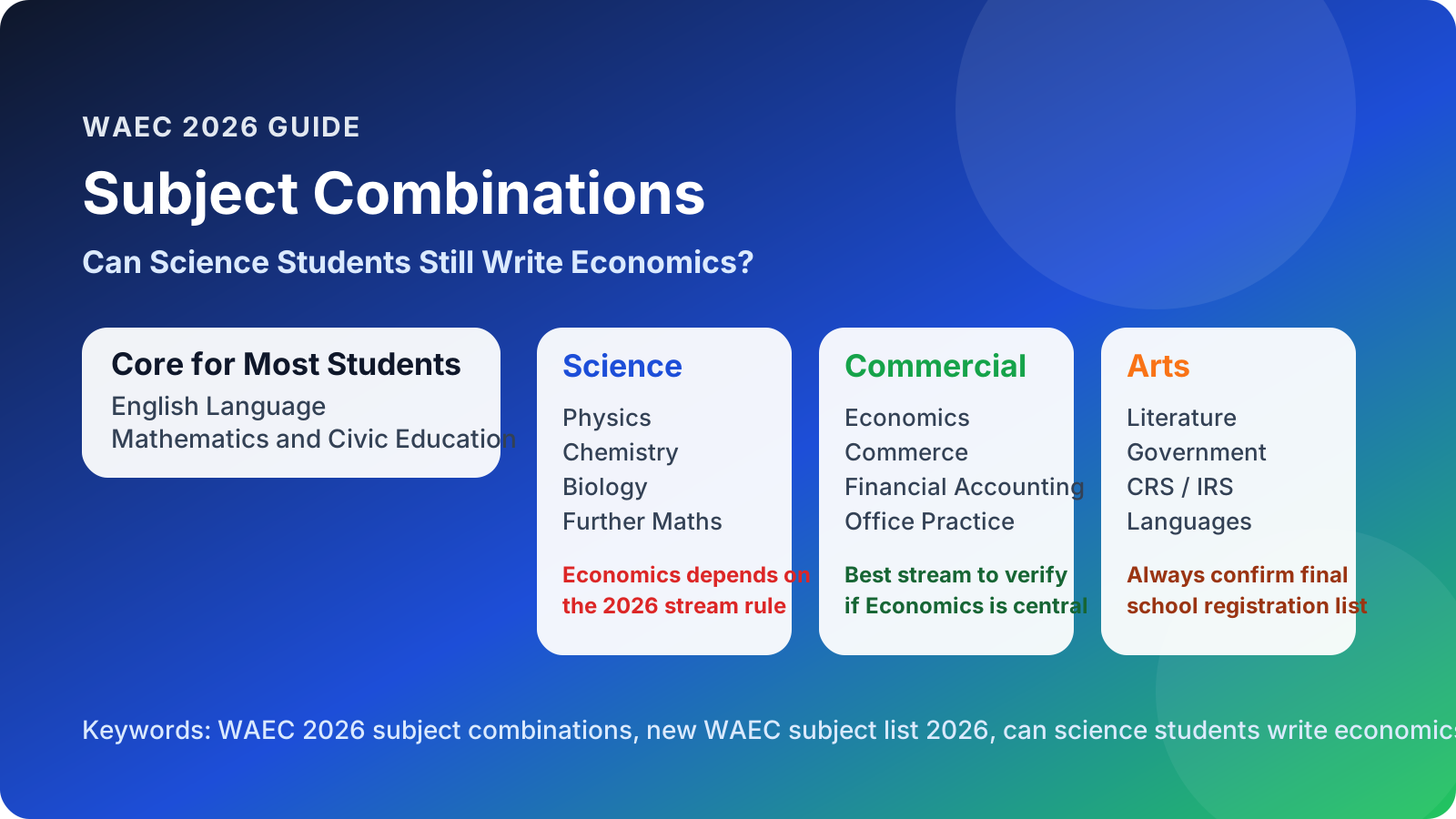
Across the current conversations, the subjects most commonly treated as universal or near-universal for WAEC 2026 are English Language, Mathematics, and Civic Education. These are the subjects students and parents should assume deserve special attention unless a school says otherwise. They sit at the center of academic progression, and they also shape how schools build the rest of the subject combination around each student.
That does not mean every candidate will have the exact same full list. Science students still need science electives. Commercial students still need business-focused subjects. Arts students still need humanities-focused papers. But those three subjects are the anchor points students are hearing repeatedly, and that is why they now appear in almost every search thread about the new WAEC subject combinations.
The practical lesson is simple: do not build your 2026 plan around a favorite elective first. Build it around the immovable core first, then confirm the stream-specific electives, then compare the result with your admission path. That order prevents last-minute panic.
Suggested 2026 stream structure students should verify with their schools
The table below reflects the structure many students are now discussing and asking schools to confirm. Use it as a decision aid, not as a substitute for your school registration form.
| Stream | Core subjects commonly expected | Typical elective direction | Planning note |
|---|---|---|---|
| Science | English Language, Mathematics, Civic Education | Biology, Chemistry, Physics, Further Mathematics, Agricultural Science, Geography, Technical options where available | Choose electives that support medicine, nursing, engineering, pharmacy, science education, or technology routes. |
| Commercial | English Language, Mathematics, Civic Education | Economics, Commerce, Financial Accounting, Office Practice, Marketing where available, Government or other balancing subjects | If Economics is central to your academic plan, this is the stream most students should verify first. |
| Arts / Humanities | English Language, Mathematics, Civic Education | Literature in English, Government, CRS or IRS, History where available, languages, arts-oriented combinations | Choose subjects that align with law, communication, education, theatre, religious studies, and humanities routes. |
One reason this table matters is that students often mix what they like with what the stream actually permits. That is how people end up with a subject profile that looks interesting but is academically weak. The purpose of a subject combination is not to show personality. It is to support exam success and future eligibility.
So, can science students still write Economics in WAEC 2026?
If your school has adopted the reported 2026 stream-based rule, the short answer is usually no. In that situation, Economics is treated as a commercial-stream subject, and science students are expected to remain inside a science-focused elective structure.
But the safer full answer is this: do not rely on a general answer when your real situation is school-specific registration. Some students ask this question online as though WAEC registration is the same everywhere at the same time. In reality, your school is the operational gatekeeper. The school chooses the final set of approved subjects, submits entries, and enforces stream arrangements. That is why one student may hear "you cannot write Economics" while another hears "our school stopped allowing it last session already."
If you are a science student asking this question because you want Economics for university admission, you need to separate three issues. First, is Economics still available to you in your WAEC registration? Second, if not, does your intended course actually require Economics, or does it only prefer it? Third, are there other acceptable pathways, such as choosing a commercial stream earlier, adjusting your O-level strategy, or balancing with UTME subject choices later? Until you answer those three questions, the search term alone will not solve your problem.
If you are a science student
Confirm immediately whether your school still permits Economics. If the answer is no, pivot early instead of assuming you can correct it later.
If you are a commercial student
This is the moment to double-check that Economics, Commerce, and Accounting appear correctly on your registration list.
If you are a parent
Ask the school for the exact subject list already assigned to your child, not a verbal summary. Written confirmation prevents confusion.
Why the Economics restriction matters more than students think
Some students think the issue is only about losing one familiar subject. It is bigger than that. Economics sits close to several future goals: business administration, accounting, entrepreneurship, finance, economics itself, and social-science related courses. Even where a course does not strictly require Economics at O-level, students often choose it because it strengthens their academic story and makes later study more intuitive.
That means the restriction has two effects. First, it changes how students distribute effort inside senior secondary school. Second, it forces earlier specialization. A student who is genuinely business-oriented can no longer stay half-science, half-commercial just because it feels flexible. They may have to choose a clearer direction sooner.
This is not always bad. In fact, clearer stream alignment can help students build stronger focus. A science student who stops forcing Economics into an already heavy list may perform better in Physics, Chemistry, Biology, and Mathematics. A commercial student who leans fully into Economics, Commerce, and Financial Accounting may develop a more coherent exam profile. The real problem is not specialization. The real problem is finding out too late.
How to think about admission if your subject combination changes
Admission planning should now be part of WAEC subject planning from the beginning. If you are aiming for Medicine, Nursing, Pharmacy, Engineering, Computer Science, or a major science course, your concern should be whether your science core is strong enough. If you are aiming for Accounting, Economics, Banking and Finance, Business Administration, or related commercial fields, your concern should be whether your WAEC profile clearly supports that direction.
What often goes wrong is that students assume UTME will solve everything later. It will not. WAEC subject combinations and UTME combinations should support each other, not fight each other. If you keep the wrong WAEC profile and then choose a UTME combination for a different direction, you create stress that could have been avoided months earlier.
Admission planning checklist
- Write down your intended course or your top three possible courses.
- Ask your school which WAEC 2026 subject combination they have approved for your stream.
- Compare that list with the O-level expectations for your intended course.
- If Economics is important to your plan, confirm whether your stream still permits it.
- Resolve the conflict before registration closes, not after mock exams begin.
Five mistakes students and parents should avoid immediately
1. Assuming a subject is available because it used to be available
That is exactly how people get trapped by policy changes. The 2025 expectation is not the same as the 2026 registration list.
2. Building a subject list from social media comments
Discussion threads can alert you to a change, but they cannot replace your school's final registration document.
3. Choosing subjects without linking them to a course plan
A student who wants a commercial course should not stay casual about whether Economics appears in the final list.
4. Waiting too long to ask the school
Many registration problems are easy to correct early and stressful to correct late. Ask while there is still time to adjust.
5. Ignoring the subjects that actually move grades
Even while you settle the Economics question, keep revising the core papers. English, Mathematics, and stream-specific high-weight subjects still determine how strong your result looks overall.
What a smart student should do this week
First, request your exact subject list. Second, if you are a science student asking about Economics, ask the school directly whether the subject is still approved for your stream in 2026. Third, compare that answer with your admission goal. Fourth, if your future path is commercial or business-heavy, do not wait for confusion to clear itself. Make a structured decision while change is still possible.
Once the registration question is settled, move back into revision quickly. Subject-combination stress easily steals study time. That is why students should lock the administrative side down early and then return to performance. If your stream is science, use the platform to keep sharpening Biology, Chemistry, and Physics. If your stream is commercial, balance Economics practice with strong English and Mathematics revision. If you want broader planning help, the Commerce study guide and the Economics preparation guide are useful next reads.
Frequently asked questions
Can science students still write Economics in WAEC 2026?
If your school is following the reported 2026 stream rule, they usually cannot. But because registration works through schools, verify the final approved list with your school before treating any online answer as final.
What are the compulsory WAEC subjects in 2026?
The most commonly referenced core subjects are English Language, Mathematics, and Civic Education. Your school then adds stream-specific electives around them.
What should a student do if Economics is removed from their science combination?
Confirm whether the intended course truly requires Economics, ask whether a stream change is still possible, and make the correction before registration closes. Do not leave it unresolved until after exams begin.
After you settle your subject list, return to score-building work.
Strengthen the core papers and the electives that remain in your approved stream using our free CBT practice mode.
Start Free WAEC Practice