Quick answer
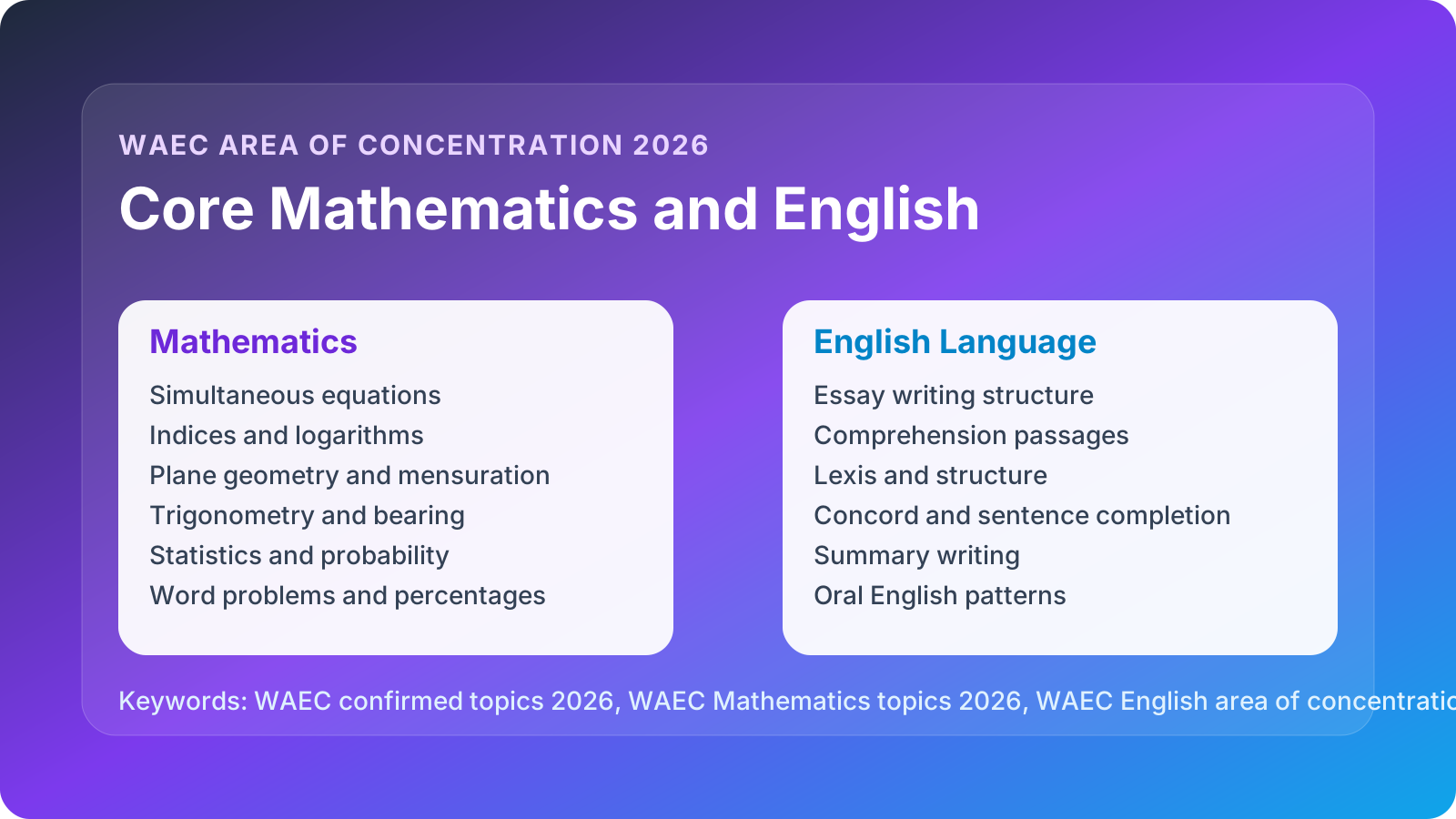
If you have limited time, start with the Mathematics topics that generate repeatable marks through method and pattern recognition, then attack the English areas that reward structured practice. For Maths, that means simultaneous equations, indices, plane geometry, mensuration, trigonometry, statistics, and percentage-based word problems. For English, it means essay writing, comprehension, summary, concord, sentence structure, and oral English. Then, very importantly, test your knowledge on these exact topics using our free CBT practice mode.
Jump to a section
Why students keep searching for WAEC confirmed topics 2026
The phrase WAEC confirmed topics 2026 looks simple, but it comes from a real pressure point. Students are not always asking for a magical shortcut. Many are asking a more honest question: if I have one week, two weeks, or even a weekend left, what parts of the syllabus should get my best concentration first? That is why the related search term WAEC area of concentration 2026 becomes popular every exam season.
There are two wrong ways to respond to that pressure. The first is to chase fake leak lists. The second is to freeze because the syllabus looks too wide. The right answer is a structured middle path: identify the topic families that appear regularly, understand the sub-skills inside them, and practice under realistic conditions. That approach is especially important for Core Mathematics and English because both subjects affect nearly every candidate and both punish shallow revision.
Mathematics is not hard because it has too many numbers. It becomes hard when a student cannot recognize which method a question is asking for. English is not hard because it has too many words. It becomes hard when a student reads without strategy, writes essays without structure, and revises grammar without using it. A good concentration guide fixes those problems by turning a wide syllabus into a ranked action plan.
WAEC Core Mathematics 2026: the topics you should revise first
When students search for WAEC Mathematics topics 2026, they are usually trying to separate high-yield areas from the parts they only understand halfway. The truth is that the strongest Mathematics revision comes from topics that do three things at once: they appear frequently, they build confidence when mastered, and they improve how you attack other questions.
| Topic | What to master | Why it matters |
|---|---|---|
| Simultaneous equations | Elimination, substitution, word-problem translation, checking final answers | Builds algebra confidence and appears in direct and applied forms. |
| Indices and logarithms | Laws of indices, standard form, simplifying powers, basic logarithmic manipulation | Students lose simple marks here because they forget rules under pressure. |
| Plane geometry and mensuration | Angles, polygons, circles, perimeter, area, surface area, volume | These topics show up often and reward formula accuracy. |
| Trigonometry | Right-angled triangles, bearings, angle relationships, sine/cosine/tangent use | Important for question-solving speed and diagram reading. |
| Statistics and probability | Mean, median, mode, range, charts, tables, simple probability statements | Common, practical, and often easier to secure once you practise calculation flow. |
| Percentages and variation | Profit and loss, discounts, direct and inverse variation, everyday word problems | These are score-builders because the context is familiar but precision still matters. |
1. Simultaneous equations
This topic is high priority because it sits at the meeting point of algebra and interpretation. Many students can solve a straight pair of equations when the numbers look neat, but they panic when the question comes as a story problem. That is why your revision must include both forms. Practise identifying the unknowns first, setting up the equations correctly, and only then solving them. A student who rushes straight to manipulation without translating the question properly usually solves the wrong problem perfectly.
2. Indices, logarithms, and standard form
These areas look technical, which makes some students avoid them until it is too late. That is a mistake. Indices are rule-driven. Once you know the laws and practise enough examples, the topic becomes one of the cleanest ways to secure marks. The main danger is careless sign errors and forgetting whether powers are multiplied, divided, or raised again. Build a one-page summary sheet and redo short drills repeatedly until the rules become automatic.
3. Plane geometry and mensuration
Geometry and mensuration are part memory and part judgment. You must know formulas, but you also need to recognize what the diagram is actually asking. Some students know the area formula for a circle and still fail because the question wanted circumference, sector proportion, or a combination of shapes. The fix is to practise diagram reading and label everything clearly before you calculate.
4. Trigonometry and bearings
Students often treat trigonometry like a topic for naturally gifted Mathematics learners. That mindset is wrong. Basic WAEC trigonometry becomes easier when you slow the topic down into triangle recognition, angle identification, and choosing the correct ratio. Bearings add a real-life context, which is why they confuse students who memorise formulas without understanding direction or angle measurement from north. Draw the situation neatly and the problem becomes far less intimidating.
5. Statistics, probability, and interpretation
These topics are score-builders for disciplined students because they are usually straightforward once you know the steps. Where people lose marks is not the arithmetic alone. It is reading the table badly, forgetting to count frequencies correctly, or misunderstanding what the question wants. If you practise them with calm working steps, they can become one of your safest topic zones.
Mathematics revision rule
Never finish a Maths topic with reading alone. After every topic block, solve timed questions. If you revise simultaneous equations today, answer simultaneous-equation questions today. If you revise mensuration today, solve mensuration questions today. That is how you convert recognition into performance.
WAEC English Language 2026: the areas you should not postpone
The search phrase WAEC English topics 2026 usually hides a deeper worry: students know English is broad, but they are unsure which areas are still capable of improving quickly. The answer is that English responds well to structure. A student who organises essay writing, reading strategy, grammar revision, and oral practice properly can still make strong gains late in the season.
Essay writing
Learn how to plan before you write. Strong introductions, clear paragraphing, and relevant examples matter more than decorative vocabulary.
Comprehension
Train yourself to read for the question, not just for the story. Precision beats speed when the passage is tricky.
Concord and structure
Subject-verb agreement, tense consistency, pronouns, modifiers, and sentence logic remain major score zones.
Summary and oral English
Students who practise compression and sound distinctions early reduce exam-day panic significantly.
1. Essay writing
If you want a fast return in English, essay writing is one of the best places to focus because improvement here comes from system, not luck. A good essay has a direct answer to the question, a sensible plan, clear paragraphs, and examples that fit the topic. Many students lose marks because they write a lot without actually responding to the title. Spend time learning how to identify the purpose of the essay prompt: narrative, descriptive, argumentative, or formal writing. Then build a simple planning habit before every practice essay.
2. Comprehension
Comprehension rewards accuracy. Students fail it when they paraphrase badly, copy too much, or ignore the wording of the question. Before reading the full passage, look at the questions briefly so your mind knows what to search for. Then read the passage with purpose. If a question asks for the meaning of a word in context, do not give a dictionary definition that ignores the sentence. If it asks for the writer's attitude, search for tone clues.
3. Concord and lexis and structure
Grammar revision becomes useful when you stop seeing it as a list of disconnected rules. Concord is really about relationships inside a sentence: subject with verb, pronoun with noun, tense with time idea, modifier with what it qualifies. That is why random memorisation helps less than sentence analysis. Break sentences apart. Ask what the true subject is. Ask whether the verb agrees with it. Ask whether the option sounds normal because it is correct, or because you have heard the wrong structure often.
4. Summary writing
Summary punishes students who cannot compress ideas. The goal is not to rewrite the passage with smaller words. The goal is to extract the points requested, remove padding, and express them in clean sentences. Practice identifying the exact points first before writing anything. That one habit alone prevents many weak summaries.
5. Oral English
Some students leave oral English until the final moment because it feels abstract. It becomes less abstract when you group sounds by contrast. Practise vowel pairs, consonant clusters, stress placement, and silent-letter traps. The Oral English guide will help you go deeper here if this is one of your weak spots.
Test your knowledge on these exact topics using our free CBT practice mode.
After reading a topic, open practice immediately. Topic-first revision plus same-day testing is one of the fastest ways to improve both Maths and English.
Open Free CBT PracticeBest revision order if you have limited time
If you only have a short revision window left, do not keep jumping randomly between difficult chapters. Use an order that builds confidence early and still touches the highest-return areas.
| Day block | Mathematics priority | English priority |
|---|---|---|
| Days 1-2 | Simultaneous equations, percentages, variation | Essay planning, concord drills |
| Days 3-4 | Indices, logarithms, standard form | Comprehension and vocabulary in context |
| Days 5-6 | Geometry, mensuration, angle questions | Summary writing and sentence structure |
| Days 7-8 | Trigonometry, bearings, statistics | Oral English and mixed objective practice |
| Final days | Mixed timed papers and weak-topic correction | Mixed timed papers and targeted grammar repair |
This order works because it balances confidence topics and technique topics. It also stops you from spending three days on one hard area while neglecting easier marks elsewhere. If you need a broader approach to revision timing, the final revision checklist and the past-question guide fit well with this article.
Mistakes last-minute students keep making
Reading Maths without solving
You do not understand a method just because it makes sense while reading. Solve it yourself under time pressure.
Writing essays without plans
A five-minute plan often saves a weak thirty-minute essay.
Ignoring easier English marks
Students sometimes chase only fancy vocabulary and forget concord, summary, and direct structure questions.
Spending too long on one weak topic
Fix weakness, but do not let one topic swallow time meant for other dependable marks.
The final principle is simple: do not confuse being busy with being effective. A student who revises six topic names and practises none may feel active but still remain unprepared. A student who revises three topic families properly and tests them immediately is usually in a better position.
Frequently asked questions
What do students mean by WAEC confirmed topics 2026?
They usually mean the syllabus areas worth prioritising first in final revision. It is better to think of them as high-priority concentration areas, not leaked questions.
Which Mathematics topics should I revise first?
Start with simultaneous equations, indices and logarithms, plane geometry, mensuration, trigonometry, statistics, and percentage-based word problems.
Which English areas matter most late in revision?
Essay writing, comprehension, summary, concord, sentence structure, and oral English are the best final-revision focus areas.
Do not stop at reading.
Test your knowledge on these exact topics using our free CBT practice mode, then review every wrong answer before moving to the next revision block.
Start Maths and English Practice