Quick answer
If you want to pass WAEC CBT, train the exam the same way you will sit it. Learn your time budget, answer straightforward questions quickly, move on when a question starts to trap you, and use a practice platform that teaches you how to navigate without wasting mental energy. Knowledge plus digital fluency is what makes CBT scores stable.
What you will learn
Why CBT feels harder than paper for many students
Students often say, "I knew the answer, but the screen threw me off." That sentence reveals the real problem. CBT introduces a second workload that paper exams do not highlight as strongly. On paper, page-turning, marking, and scanning often feel natural because students have done them for years. On a computer or tablet, a student must read, select, track the timer, and decide whether to move on, all while staying calm. That extra layer affects performance even when the content is familiar.
Another reason CBT feels harder is that the clock becomes more visible psychologically. Even if the total time is fair, the presence of a visible timer can speed up panic in students who have not trained under realistic conditions. Some begin to rush because they can see time disappearing. Others freeze because they do not know whether they are fast enough. Both problems come from lack of rehearsal, not lack of ability.
There is also the issue of digital rhythm. In a paper exam, some students underline, circle, or place a finger beside a line while thinking. On a screen, they lose those little habits and feel less anchored. That is why good CBT preparation includes more than past questions. It includes repeated exposure to the movement patterns of the exam itself.
How the CBT interface usually works
Most CBT environments ask you to do the same core actions: read one question at a time, select an answer, move to the next question, return to previous questions if needed, and submit before time expires. Some interfaces also allow review screens or status indicators that show answered and unanswered items. Students who understand these mechanics before exam day save attention for the questions themselves.
Read the question stem first
Train your eyes to locate the real task before you dive into the options. This prevents wasting time on information that does not matter.
Select confidently
Once you know your answer, click it deliberately. Do not keep changing answers without a clear reason.
Move with control
Next and previous buttons should feel routine, not stressful. Slow, confused navigation steals time silently.
Review strategically
Do not review every question equally. Review the few that truly need a second look.
A strong CBT candidate never waits until exam day to learn the interface logic. They already know how to settle down, read the first question, answer what is answerable, and avoid getting stuck. That is why repeated digital practice matters so much. It reduces novelty, and reduced novelty usually means lower panic.
Time management that actually works in WAEC CBT
Time management is not just "be fast." Real time management means deciding what pace belongs to easy questions, medium questions, and problem questions. The first thing to do in any CBT paper is calculate your average time per question. Even if you do not follow the average perfectly, it gives you a ceiling. Once you know the average, you stop pretending that every question deserves unlimited attention.
| Exam situation | What to do | Why it works |
|---|---|---|
| You know the answer quickly | Answer and move on immediately | You are saving time for harder items later. |
| You are torn between two options | Use brief elimination, decide, and mark mentally for review if the interface allows | Prevents one stubborn item from swallowing three easy ones. |
| The question looks unfamiliar | Do not panic. Extract what it is asking, try a fast approach, then move if still stuck | Staying too long creates timer panic for the whole paper. |
| You are behind schedule | Speed up on clearly easier questions and stop overthinking medium ones | Recovery is possible if you do not waste more time trying to be perfect. |
A useful rule for many students is this: easy questions should take less than your average, medium questions should stay close to your average, and difficult questions should not be allowed to consume two or three question slots unless they are absolutely necessary. That one rule improves exam balance immediately.
Another overlooked part of CBT time management is emotional time. A student who gets annoyed after one difficult question loses more minutes than the question itself deserved. You must learn to leave a hard question mentally when you leave it physically. Carrying frustration forward slows your next answers as well.
Navigation habits that save marks
Navigation sounds small until it starts stealing seconds from every question. In CBT, wasted seconds accumulate quietly. If you hesitate before moving to the next question, misclick frequently, or return too often to questions you already answered, you create a hidden time leak.
The best navigation habit is simple: answer, confirm internally, move. Do not hover. Do not stare at the same question because the timer is making you nervous. The second best habit is knowing when to come back. Some students revisit too early and too often. That makes them feel busy while actually slowing down. A better approach is to complete a clean first pass, then use remaining time to revisit only questions that genuinely deserve another look.
Keyboard and touch confidence can also reduce navigation drag. Students who are comfortable with keys or swipes often move more smoothly than students who over-rely on cautious mouse movement or repeated screen tapping. That does not mean you must use shortcuts on exam day. It means training multiple navigation styles can make you calmer and faster.
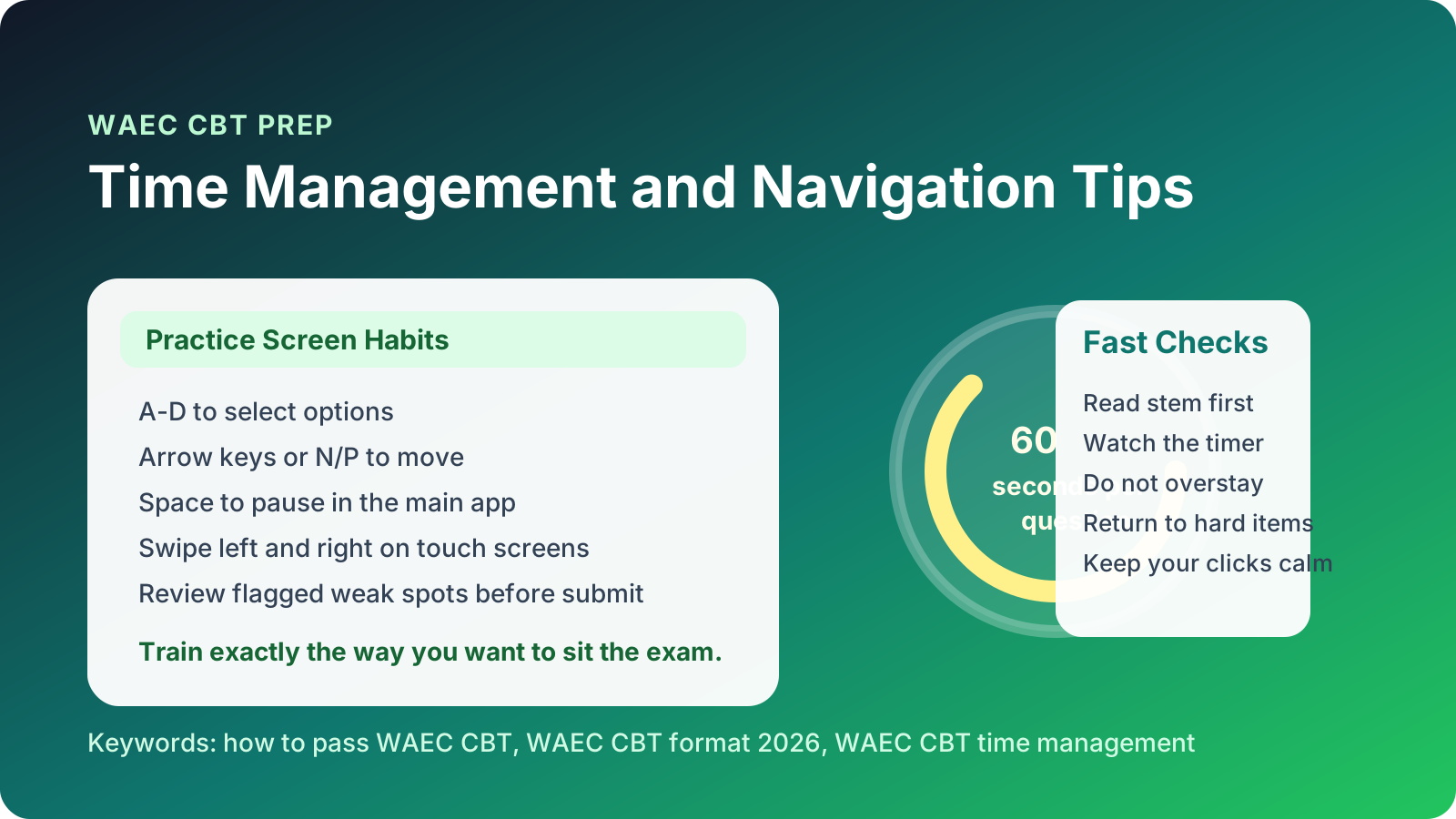
- In the main practice flow, A-D selects answer options and N / P or the arrow keys move between questions.
- The practice interface also supports swipe gestures on touch devices for moving to the next or previous question.
- In the main app, Space can pause the session and ? opens a shortcuts help modal.
Those controls are not a claim about the exact official exam software. They are training tools that help you build faster, calmer CBT habits before exam day.
How to use WAEC EXAM practice features the right way
Students sometimes use CBT platforms casually and then say they have practised. Casual use is not the same as exam training. If you want to improve, you must turn platform features into deliberate habits. Start by choosing a subject and running short timed sessions. Use keyboard selection if it helps you move faster. Try arrow-key or N/P navigation until it feels natural. If you use a phone or tablet, practise swipe movement so your hand does not feel awkward on a screen.
The goal is not to show off shortcuts. The goal is to reduce friction. Every action that becomes automatic frees a little more attention for comprehension, calculation, and judgement. That is why digital fluency is such a real performance advantage.
Students should also use practice review intelligently. After a session, do not only look at the score. Ask why wrong answers happened. Was the issue content weakness, rushing, poor screen reading, or careless navigation? If you do not classify the mistake, the platform becomes entertainment instead of preparation.
A strong CBT practice cycle
- Choose one subject or one topic set.
- Set a realistic timed session.
- Use calm navigation and avoid over-reviewing during the first pass.
- Finish the session and inspect every wrong answer.
- Repeat a second short session on the same weakness within 24 hours.
Common CBT mistakes students should stop making now
Reading too fast on screen
Students rush because the timer is visible, then misread command words and lose marks that had nothing to do with knowledge.
Overstaying on difficult items
A single stubborn question can destroy the rhythm of the whole paper if you do not know when to leave it.
Practising without review
Scores improve when wrong answers are analysed, not just noticed.
Ignoring device habits
Some students never practise on touch screens or never learn keyboard flow, then feel clumsy on exam day.
Another mistake is assuming subject mastery automatically produces CBT mastery. It does not. A brilliant student can still underperform digitally if they are unsettled by timers, navigation, or screen-reading fatigue. That is why training format and content together is so effective.
A 7-day CBT adaptation routine
If CBT still feels unfamiliar, use this one-week routine before the exam season gets too close:
| Day | Focus |
|---|---|
| Day 1 | Short untimed session to get comfortable with question flow and screen reading. |
| Day 2 | Timed session with deliberate next and previous navigation. |
| Day 3 | Use keyboard shortcuts or touch gestures during practice until movement feels calm. |
| Day 4 | Run a mixed-subject session and review every wrong answer by cause. |
| Day 5 | Practise recovery: skip hard items, keep pace, then return later. |
| Day 6 | Take a longer full-length session under stricter timing. |
| Day 7 | Review weak patterns and repeat a shorter confidence-building session. |
This routine works because it treats CBT skill as trainable. By the end of the week, the interface stops feeling like part of the problem. That alone can improve score stability.
Frequently asked questions
How can I pass WAEC CBT if I am used to paper exams?
Practise the format deliberately. Learn to read on screen, answer quickly, move smoothly, and track your timing without panic.
How much time should I spend per question?
Use the average-time rule based on total questions and total time, then keep easy questions below that average so difficult ones do not consume the whole paper.
What should I practise before exam day?
Answer selection, next and previous movement, timer awareness, review strategy, and calm interaction with the screen. That is where free CBT practice helps most.
Best next step: stop imagining CBT and start rehearsing it.
Use our free CBT practice mode to train navigation, timing, and review habits in the same session you revise content.
Start WAEC CBT Practice