Quick answer
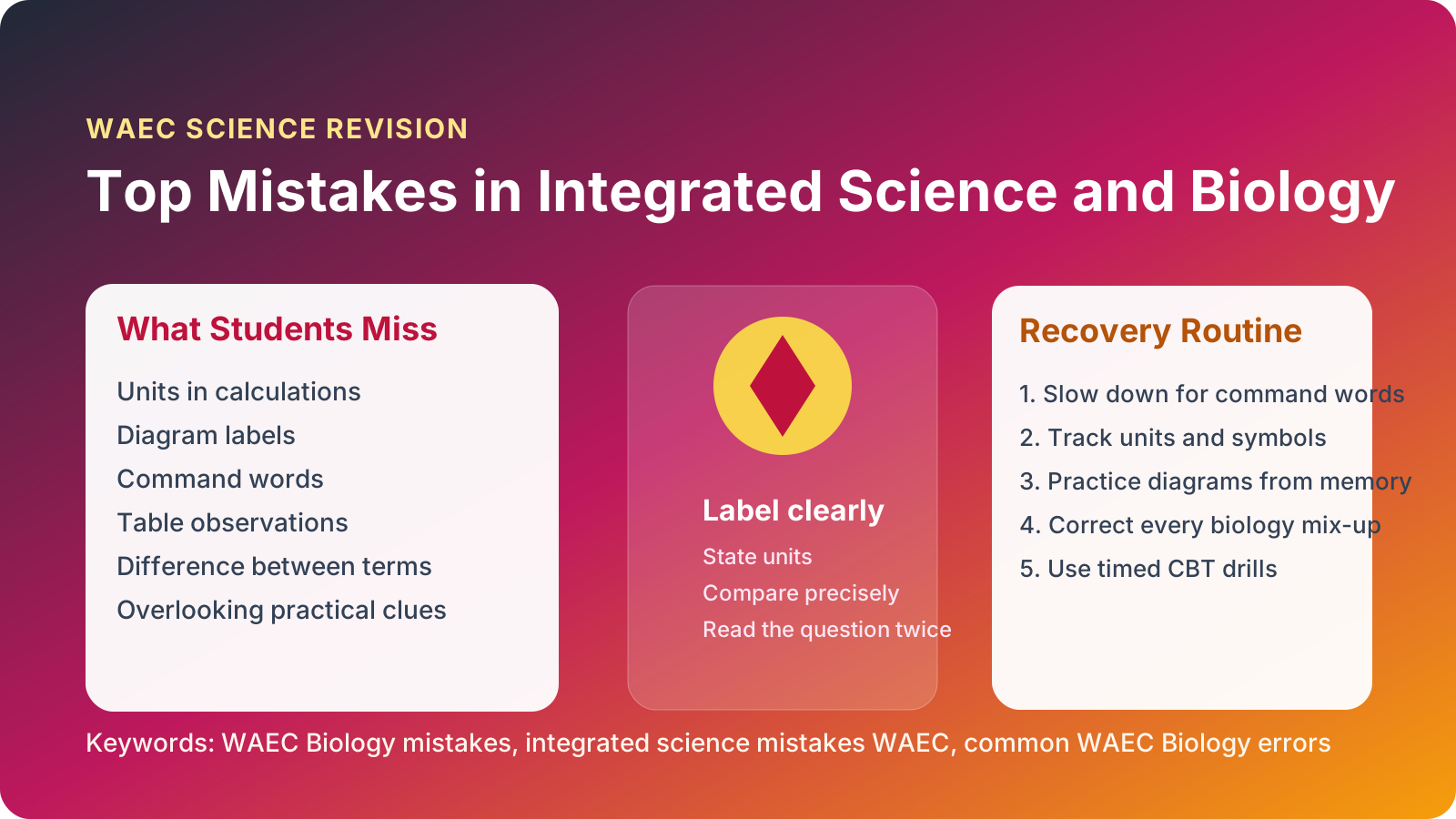
The most common WAEC Biology and Integrated Science mistakes are not mysterious. Students misread command words, drop units in calculations, label diagrams badly, confuse similar terms, write weak practical observations, and spend too long on the wrong questions. The good news is that all of these are fixable if you review them deliberately instead of revising randomly.
Inside this guide
Why mistake patterns matter more than random revision
Many students revise Biology and Integrated Science by covering chapter after chapter without asking a better question: where exactly do I keep losing marks? That approach feels productive because it is full of activity, but it does not always change performance. Performance changes when you stop treating every weakness as equal and start tracking the exact kinds of errors that repeat under pressure.
Science subjects are especially sensitive to this because the same small habits show up across many topics. A student who forgets units in one calculation may do it again in density, work, respiration rate, or ecology-related data. A student who labels a Biology diagram carelessly may also write careless practical observations. A student who misreads the words "state," "explain," and "differentiate" can lose marks across the entire paper no matter how much content they have covered.
That is why a structured listicle can be so useful. It gives you a mirror. Once you recognise your own error pattern, your next practice session becomes purposeful instead of random.
The top 10 common mistakes students make
1. Misreading command words
Students often know the topic but still answer the wrong task. A question may say state, but the student starts explaining. It may say differentiate, but the student gives two isolated definitions without comparison. It may ask for functions, but the answer becomes a long paragraph around the topic without the required points.
The fix is to pause for the command word before reading everything else. In science papers, command words control mark allocation more than many students realize. If the command word changes, the correct answer structure changes too.
2. Forgetting units in calculations
This is one of the most painful ways to lose marks because the student may perform the whole calculation correctly and still finish badly. Units matter in Integrated Science because the subject connects calculations to measurable reality. If you calculate speed, density, pressure, temperature change, or any measurable quantity, the unit is part of the answer, not an optional decoration.
The fix is mechanical: circle the given units before solving, carry them mentally while working, and check the final answer line before moving on. Build the habit until it becomes automatic.
3. Poor diagram labeling in Biology
Some students know the structure they are drawing but still lose marks because the drawing is untidy, the label line does not touch the correct part, or labels cross over each other in a confusing way. Biology rewards clarity. A neat simple diagram usually scores better than an ambitious untidy one.
The fix is to practise standard diagrams from memory and keep your label lines straight, horizontal where possible, and correctly aligned with the parts they identify. If you need deeper practical support, the Biology practical guide is a useful next step.
4. Confusing similar scientific terms
Biology and Integrated Science are full of near-neighbour concepts: osmosis and diffusion, respiration and breathing, habitat and niche, weight and mass, fertilization and implantation, artery and vein. Students often revise them separately but never compare them directly, so they confuse them under pressure.
The fix is not more random reading. The fix is side-by-side comparison practice. Put the terms next to each other and list the exact differences until they become unmistakable.
5. Writing definitions without process understanding
A student may memorise a neat definition of photosynthesis, respiration, excretion, or adaptation and still fail a question that asks how the process works or why it matters. WAEC science questions often test understanding, not just labels.
The fix is to connect every definition to a simple process chain. Do not stop at what it is. Ask how it happens, where it happens, what it produces, and why it matters.
6. Weak practical observations
In practical-style questions, students sometimes write what they think should happen instead of what the observation actually shows. That difference matters. Science is disciplined observation, not guesswork. If a colour changes, name the colour change. If bubbles appear, say so. If the temperature rises, state it clearly.
The fix is to practise observation language. Learn how to describe what is seen before interpreting why it happened.
7. Ignoring graphs, tables, and data presentation
Some students focus heavily on textbook theory and then lose marks when the question presents data instead of ordinary sentences. They rush graphs, ignore headings, read scales wrongly, or copy values carelessly.
The fix is to treat tables and graphs as first-class revision topics. Read axes properly, check units, and describe trends with exact language. Data literacy is part of science performance.
8. Answering Biology with vague language
Words like "things," "moves," "helps," or "goes" are weak in science answers when a more exact term is needed. Biology often expects more precise language: absorbs, transports, secretes, diffuses, contracts, filters, conserves, reproduces, or supports.
The fix is to build a vocabulary bank from past questions and mark schemes. The more accurate your language, the safer your marks.
9. Neglecting recurring topic zones
Students sometimes keep revising their favourite chapters and quietly avoid the areas that keep returning in exams: ecology, nutrition, transport systems, reproduction, human health, simple machines, energy, environment, and practical reasoning. Avoidance feels safe until it shows up in the exam hall.
The fix is to identify the topics you keep postponing and put them into a mandatory revision block, even if you do not enjoy them. Growth often hides inside the topics you keep avoiding.
10. Poor time distribution between sections
Some students spend too much time on objective questions because they keep changing answers. Others rush theory because they arrive there late and tired. In science exams, this hurts badly because later sections often reward structured thought and clear presentation.
The fix is to practise full or half-length timed sessions and learn your section rhythm before exam day. Time management is not only for Mathematics and English. It matters in science as well.
Marks you can protect
Units, labels, neat tables, exact observation phrases, and command-word discipline are all mark-protection habits.
Marks you can grow
Topic comparison, practical reasoning, graph reading, and timed practice can increase your score more quickly than passive reading.
Best next action
After reading this article, practise one short Biology or science set and label every mistake by type.
A fast repair plan for the next seven days
If you recognise yourself in several mistakes above, do not panic. Panic wastes the time that could solve the problem. Use a short repair plan instead. The table below is designed for students who want quick improvement before a major paper.
| Day | Main repair task |
|---|---|
| Day 1 | Review command words and do one mixed set with slow, careful reading. |
| Day 2 | Practise calculations only and write units on every final answer. |
| Day 3 | Redraw key Biology diagrams and label them neatly from memory. |
| Day 4 | Do a terminology-comparison drill: paired terms, differences, examples. |
| Day 5 | Practise observation writing using tables, colours, shapes, and trends. |
| Day 6 | Take a timed mixed session and keep an error log. |
| Day 7 | Repeat the weakest area and finish with a calmer timed review set. |
Error-log rule
Every science practice session should end with this sentence: Why exactly did I lose these marks? If the answer is always vague, improvement stays vague. If the answer becomes specific, improvement becomes specific too.
Science confidence grows when you start seeing your mistakes as categories instead of as proof that you are "bad at Biology." A student who keeps an error log and practises targeted corrections often improves faster than a student who reads more chapters without examining their habits.
Frequently asked questions
What mistakes cost students the most marks in WAEC Biology?
Misreading command words, dropping units, writing vague definitions, and labeling diagrams badly are among the most common and most preventable problems.
How do I stop repeating mistakes?
Keep an error log, group mistakes by type, and practise corrections by category instead of revising randomly.
Do practical presentation and diagrams really matter?
Yes. Clear labels, neat presentation, and accurate observations often protect easy marks that students throw away carelessly.
Turn these mistakes into a score advantage.
Open a Biology or science practice session now, then correct every wrong answer by mistake type before you stop.
Start Biology Practice